Measuring seed quality
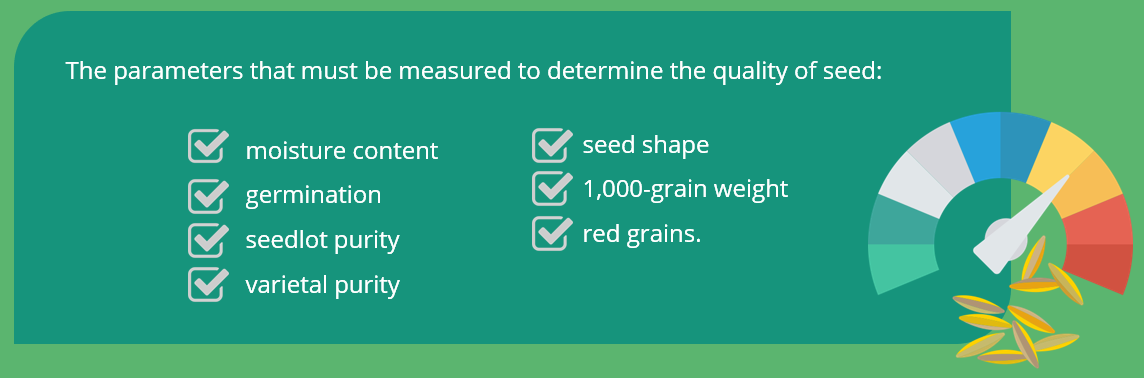
Many countries have their own standards that these parameters can be measured against.
1. Moisture content (MC)
There are two methods that can be used to measure MC. The primary or direct method, often called the oven-drying method, and the secondary method using electronic moisture testers.
Oven-drying method: This oven-drying method takes longer to perform, but provides the most reliable MC measurement. It is based on weight reduction. The sample is weighed and then placed in an oven until all water is removed and weighed again. MC is then calculated based on weight loss. Since weight measurements are highly accurate, this is the most accurate method.
- Set the oven at 130oC.
- Take the initial weights [mi] of three 100-gram seed samples.
- Place the three samples inside the oven and leave for 16–24 hours.
- Measure the final weight [mf] of each sample after the 16–24 hours.
- Compute the MC for each sample using the equation:

- Compute the average over three samples to obtain a reliable measure of the moisture content
Electronic moisture meter: This method uses a meter that measure the MC either by measuring the resistance or capacitance of a paddy sample.
- Read the operator’s instructions.
- Turn the moisture meter on.
- Ensure the machine is set for paddy.
- Fill the tray or bowl of the moisture tester with a sample of the paddy to be tested.
- Turn or press the knob until it is fully closed. The moisture is displayed.
- Test at least three samples and calculate the average of the three readings.
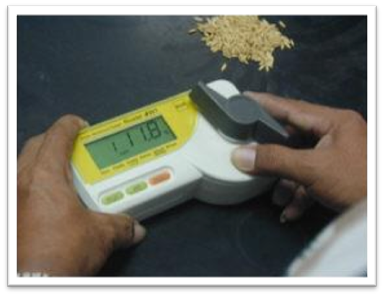
Moisture meters are most reliable after they have been calibrated. To do this, use the drying oven method to determine an accurate MC reading for a paddy sample. Test a sample from the same batch using the moisture meter and compare the results.
2. Germination test
A germination test is often the only test a farmer can conduct on the seed before planting. Monitoring the time taken to germinate will also give an indication of vigor.
Sampling: If the seed to be tested is from a seedlot contained in more than one bag, sample must be taken from several bags. A good rule of thumb for determining how many bags to sample is to take samples from a number of bags that represents the square root of the lot size. For example, if the lot contains nine bags, then sample at least three bags. If the lot contains 100 bags, then sample from at least 10 bags.

Procedure: Follow these steps.
- Place water-absorbent material inside the waterproof tray.
- Take random sample from each seed lot and mix in a container.
- Take at least three seed samples from the mixed grain.
- Count out 100 seeds from each sample and place on the water-absorbent material inside the tray.
- Carefully saturate the absorbent material.
- For each of 10 days: (1) check each day that the absorbent material remains most and (2) record the number of germinated seeds.
- Compute germination data for 5 days and for 10 days

The rate of germination is an indicator of vigor. Rapid seed germination increases the chance that seed will establish in the field.
Calculating the germination rate: Germination rate is the average number of seeds that germinate over the 5- and 10-day periods.

For example, if 86 seeds germinated in a tray of 100 seeds after 10 days, then 10-day germination (%) = 86 x 100/1 = 86%
3. Seedlot purity
The impurities measured to test the purity of the seed batch are:
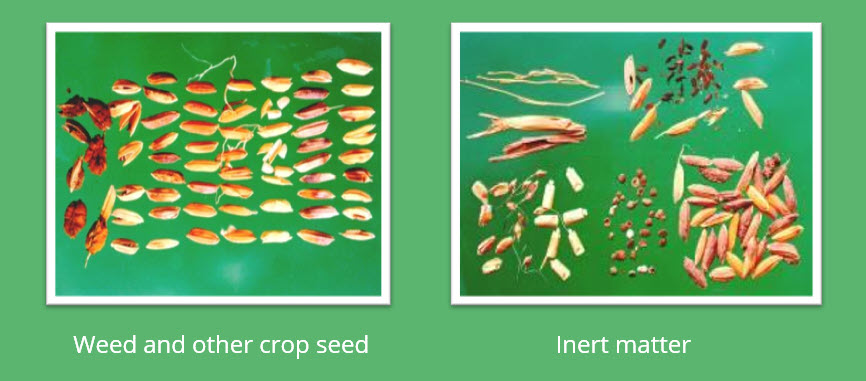 Procedure: Follow these steps.
- Select, at random, a sample of the seed. 100 g is a good sample size.
- Weigh the sample [A].
- Remove all of the weed and other crop seeds and the inert matter.
- Weigh the weed and other crop seed matter removed [B].

- Compute the weed percentage as follows:

- Weigh the inert matter removed from the sample [C], the inert matter percentage is calculated using the formula:

4. Varietal purity
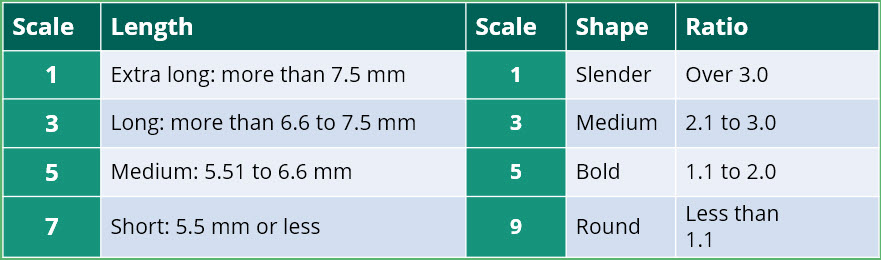
Grain dimensions: The grain size and shape (length to width ratio) is a very stable varietal property that can be used to measure the varietal purity of a sample. Comparing the length to width ratio of the sample with the published ratio for the variety indicates the varietal purity of the grain sample. Significant deviation indicates that the sample is impure, so it is either a different variety or a mixture of varieties.

Procedure: Following these steps:
- Obtain a random sample from the seed batch.
- Collect 20 grains at random from this sample.
- Use a Vernier caliper or photographic enlarger to measure the dimensions of each of the 20 grains.
- Tabulate the length and width of the grains and calculate the average.
Seed shape: To obtain the seed shape, the length to width ratio, use the following equation:

5. Weight-based sampling
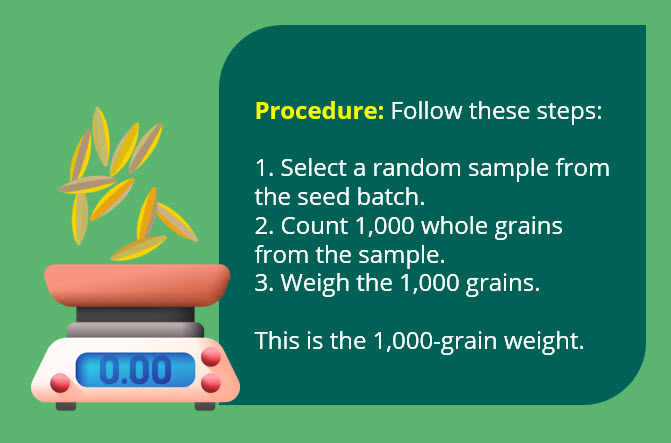
A second characteristic that measures varietal purity is the 1,000-grain weight. Each variety has a published weight for 1,000 grains. If the 1,000-grain weight calculated from the sample departs from this, it may be an indication that the sample contains a mixture of varieties.
6. Red grains
A grain is considered to be red if more than 25% of its surface area is red-colored or streaked.
Procedure: Follow these steps:
- Mill the sample.
- Select a random sample of the milled rice: 25 g is a good sample size.
- Weigh the sample [A].
- Select and separate the red grains from the sample. The red kernels are those that have 25% or more of the grain red.
- Weigh the red grains separated from the sample [B]. Calculate the percentage of red grains in the sample using the formula:

7. Recording the seed batch quality
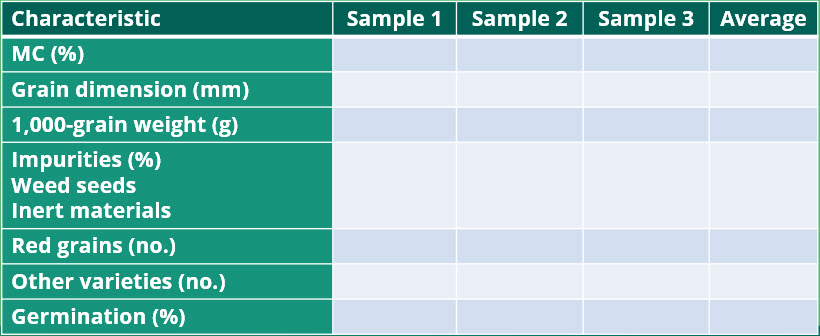
Take the sample of seed provided and conduct the range of quality tests described above. Use the test results to complete the sample spreadsheet in Table below.
Sample spreadsheet for reporting seed quality